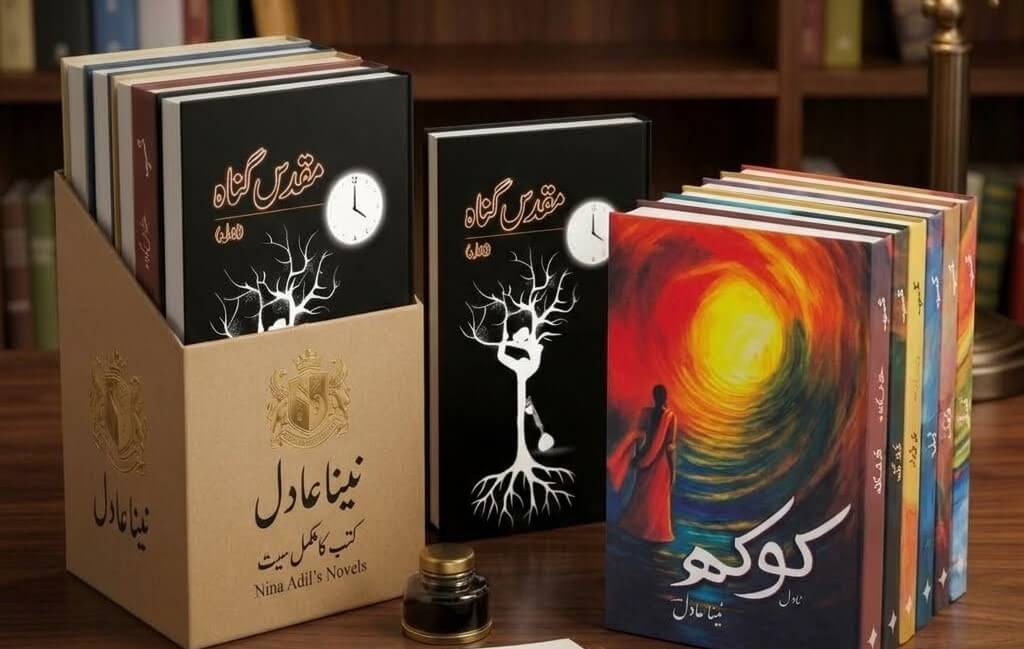
Kokh by Naina Adil
Desciption
Kokh is a contemporary Urdu novel by Naina Adil that takes its readers into the complicated relationship between memory, identity, family, and the human mind. The novel deals with difficult realities such as childhood trauma, abuse, psychological distress, emotional isolation, social expectations, and exploitation, while also leaving space for questions of resilience, connection, and recovery.
At the centre of the story is Hoorain, whose experiences during childhood continue to influence the person she becomes. Her past does not simply remain behind her; it follows her into the way she understands relationships, her own body, intimacy, fear, and the people around her. Through her journey, the novel introduces the idea that some experiences continue to affect a person long after the original circumstances have ended.
The title Kokh, meaning “womb,” provides an important framework for understanding the novel. The word traditionally evokes birth, protection, motherhood, and the beginning of life. Within the world of the novel, however, it can also suggest something more internal a place where experiences are carried, preserved, and gradually become part of who a person is. This gives the title a broader psychological significance and connects it to the novel’s recurring concerns with memory, identity, and what is carried from one generation to another.
Hoorain’s story is also closely connected with the idea of reclaiming oneself. Her experiences have affected her relationship with her body, but creative expression provides her with another way of relating to it. Her dancing becomes an important part of this journey. It gives her a private space in which movement, rather than conversation, can communicate emotions that are difficult to put into words. Art therefore becomes closely connected with her inner life.
The novel also gives considerable attention to the ways people understand mental health. Through its characters and their experiences, it explores how easily psychological suffering can be misunderstood or reduced to labels. The presence of psychiatric institutions and medical treatment introduces another layer to this discussion, bringing questions of authority, vulnerability, care, and human dignity into the narrative.
Family is equally important to the novel. Kokh looks at the things families communicate without necessarily saying them aloud. Stories, fears, habits, emotional patterns, and unresolved experiences can influence younger generations in ways that are not always immediately visible. The grandmother’s storytelling adds another dimension to this idea, connecting personal memory with cultural memory and imagination.
Alongside trauma and mental health, the novel explores relationships and the complicated nature of love. It does not treat affection as a simple cure for deeply rooted pain. Instead, relationships can offer understanding and companionship while personal healing remains an individual process. This allows the emotional relationships within the story to exist alongside, rather than replace, Hoorain’s own journey.
Kokh also moves beyond the private world of its central characters. Different forms of exploitation appear throughout the narrative, including emotional manipulation and financial deception. These elements broaden the novel’s discussion of vulnerability and power, showing how people can be taken advantage of in very different circumstances.
Naina Adil’s background as a poet can also be felt in the novel’s atmosphere and imagery. Rather than relying only on straightforward narration, the story makes room for dreams, music, dance, memories, and symbolic spaces. These elements give the narrative an introspective quality and allow the reader to experience the characters’ inner worlds alongside the events taking place around them.
The novel also brings attention to the experiences of women and the expectations placed upon their bodies and identities. Through its treatment of abuse, sexuality, motherhood, family, and autonomy, Kokh examines how a woman’s body can become a space upon which other people’s expectations and decisions are imposed. The title consequently gains another layer of meaning, drawing attention not only to motherhood and birth but to the woman whose body and identity exist beyond those roles.
Rather than presenting healing as a sudden transformation, Kokh follows a more complicated path. Its characters are shaped by what they experience, but they are not necessarily destined to remain defined by it. The movement from silence and confusion toward recognition and self-understanding becomes an important part of the novel’s emotional direction.
Ultimately, Kokh is a novel about the things people carry memories, fears, relationships, expectations, and experiences and about the possibility of deciding what to do with them. Through Hoorain and the people surrounding her, Naina Adil brings together psychological, social, and emotional dimensions to create a narrative that looks beyond visible events and into the experiences taking place beneath them.
Available on:
https://sangemeel.shop/products/kokh-naina-adil?srsltid=AfmBOoo8RqukYlllP7ABLvGVI95WBI0wbZOhLT7luNu7m5ZN4ancD8WC